
Let’s Talk(425) 358-1603

As a parent, nothing is more frightening than learning your child has gotten into trouble with the law. As a young adult, learning that you are being investigated for a crime is just as scary. Whether you’ve been charged with driving drunk on 104th Avenue SE or are being accused of hurting someone in Clark Lake Park, you need a Kent juvenile crimes lawyer who is ready to fight to protect your rights and keep your future bright.
With years of experience working as a private attorney for juveniles and being appointed as the public defender in King County for many juveniles, attorney Andrea Kim is ready to turn her time and attention to you or your child’s case. We understand that you want the safest outcome possible for your child, and we are here to meet you and your young adult wherever you are. Let us handle all of the confusing legal stuff and build you a strong defense case. You can trust us to take care of you.
The state of Washington currently sees a juvenile crime arrest rate of 1.01 per 1,000 individuals. This is an important statistic to keep in mind because it shows that just because you are accused of a crime, it doesn’t mean you’ll actually be arrested, and hiring a lawyer can make a huge difference. At ARK Law, we handle the following kinds of juvenile crime cases:
The juvenile court system can be confusing. The juvenile court system in Washington State is also drastically different from the adult court system and it is imperative that you hire an attorney who is familiar with the juvenile court system. Thankfully, that is what a Kent juvenile crimes attorney is here for. Your attorney from ARK Law can sit down with you and explain to you the entire process of juvenile crime cases and how this process can affect you. There are several important things to know about the King County juvenile court system, including:
For many youth in Kent, simply being in the wrong place at the wrong time can lead to huge life changes. Don’t let an arrest hurt your future. At ARK Law, we can look over your case and the crime you’ve been charged with, and fight to keep you out of jail. Contact our offices today to learn more information and hire a juvenile crimes lawyer.
One of the unique aspects of Juvenile Court is the role of the Juvenile Probation Counselor (JPC) during the pretrial stage of the case. Youth charged with crimes in Juvenile Court are assigned a JPC at their very first court appearance. That JPC will meet with the client and his or her family to get some background information and explain the rules while the case is pending. That same JPC will track the youth and family while the case is pending and make sure the youth is abiding by the rules and conditions put in place by the Judge.
The JPC has a very important and influential role in a Juvenile Criminal Case. The Defense Attorney and Client are on one side of the case while the Prosecutor is on the other side of the case. Because the JPC is supposed to be the neutral party that is on neither side, the Juvenile Court Judge’s rely heavily on the JPC’s opinions and recommendations. It is imperative that the youth and family cooperate with the JPC and make sure to abide by the conditions the JPC imposes. If there is a disagreement with the JPC, the attorney should handle that to try to preserve the client’s relationship with the JPC. A youth and family should speak with an attorney before speaking with or disclosing information to the JPC. Unfortunately, this can be a catch 22 because if you lie to the JPC or withhold some information and they later find out, that can severely harm the case BUT they are likely to report to the prosecutor and Court anything that the youth does wrong. That is why it is so important to discuss with an attorney any issues with your case that need to be reported to the JPC. Because the JPC is such an important part of any juvenile criminal case, it is imperative to have an attorney that knows the JPC and how to work hand in hand with that person. Andrea Kim has worked with many of the JPCs in King and Pierce County. Andrea has been successful at getting the Judge to grant resolutions to cases that the prosecutor objects to by getting the JPC on board with the Defense plan for the case. It is very important that you have an attorney experienced in Juvenile matters and experienced in the very important role the JPC plays in every juvenile case.
There are two categories of dispositions in Juvenile Court. One is Local Sanctions(LS) for less serious crimes and youth with less criminal history. The other is Juvenile Rehabilitation (JR).
One or more of the following may be imposed:
Youths are committed to what is essentially juvenile prison for a range of weeks. The Judge simply imposes the range of weeks and JR determines when the youth will be released within that range of weeks. Youths can be held in JR up until their 21st birthday, or 25th birthday in very rare circumstances, such as adjudications for Drive By Shooting or Robbery in the First Degree or with a 12 month firearm enhancement.
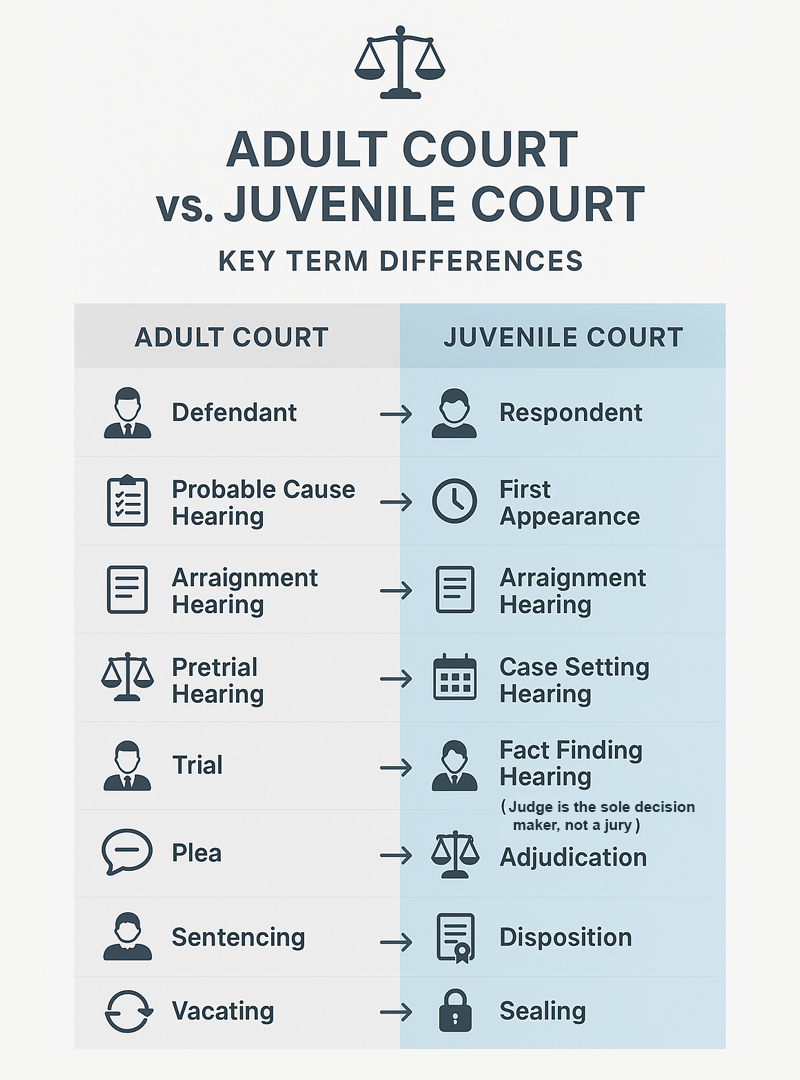
Plea and Sentencing are referred to as an Adjudication and Disposition in Juvenile Court. Because of the rehabilitative nature of Juvenile Court, there are multiple options to resolve a case without a youth having a conviction follow them around forever. Below are some of the possible disposition options unique to Juvenile Court:
Diversion actually occurs prior to any criminal charges being filed and keeps the youth from having any conviction on his or her record. However, the diversion is visible to the prosecutors and Juvenile Court Judges so that they can consider the diversion in determining how to handle future cases. The prosecutor’s office screens all referrals for charges to determine if they qualify for a diversion. A youth’s first misdemeanor referral MUST be diverted by the prosecutors office. For a youth’s second and third misdemeanor referral, the prosecutor has the discretion to refer the case to diversion but does not have to. A youth is allowed no more than three diversions. For youth charged with felonies, the only cases the prosecutor does not have the option to divert are sex offenses and violent crimes BUT as of 2019, the statute allows prosecutors to divert Assault in the Second Degree and Robbery in the Second Degree. Each prosecutors office has policies about which cases they are willing to divert. Andrea Kim has advocated for many clients to have their cases diverted when the prosecutors did not initially want to divert.
You have the right to consult with an attorney prior to deciding whether or not to enter into a diversion agreement and you should speak with an attorney to help you make that decision.
Diversion programs can last up to 6 months but oftentimes are for shorter periods. The period of the diversion can go past the youth’s 18th birthday. The conditions of diversion can include:
Youth are allowed ONE deferred disposition! Violent and sex offenses are the only charges that do not qualify for a deferred disposition. In addition, a youth must not have a prior felony on their record, or have more than two prior adjudications on their record of any crime. An attorney can help the youth decide if a particular case is the best case to use their one deferred disposition on. It is typically better to utilize it for more serious charges and when the youth is closer to their 18th birthday but that is a very individualized analysis and decision that the youth should thoroughly discuss with an attorney. The Court DOES NOT have to grant the deferred disposition but there is a presumption that it will be granted if the youth qualifies. It is best to have an attorney advocate to probation, the prosecutor and the Court why a Deferred Disposition is the right resolution for your case.
When a youth enters into a Deferred Disposition, he or she allows the judge to read through the police reports and find the youth guilty based on those reports. Then the disposition (sentence) is continued for a period of probation. This is a particularly good option for youths charged with more serious crimes who are facing time in JR (youth prison). A Deferred Disposition puts the youth in charge of whether or not they have to serve that sentence and can be very empowering for many youths. The Court then imposes a term of probation and conditions of probation. If the youth successfully completes the terms of probation, then at the end of the time period, the case is dismissed and automatically sealed. However, if the youth does not successfully complete the probation period, the guilty plea is entered and then the Court enters a disposition at that time. The youth then has to serve whatever disposition the Court imposes.
The judge is able to impose up to a year of probation initially and can extend that time period for an additional year if needed for the youth to complete conditions or pay off restitution. But two years is the maximum amount of time the Court can allow for probation on a Deferred Disposition. Potential conditions of probation on a Deferred Disposition:
If a youth violates a Deferred Disposition, the Court will hold a hearing to decide if the Deferred Disposition should be revoked. The Court has a couple of options at a revocation hearing. The Judge can decide to revoke the Deferred Disposition and sentence the youth at that time. The Court can also choose to not revoke the Deferred Disposition but impose some sort of consequence for the violation which could include: extending the period of probation (not to exceed two years in total), days in detention, Electronic Home Detention, additional community service hours, and additional classes, counseling, or treatment.
The CEDAR program was implemented in 2018. This program was designed to fast track certain first time felony offenses so that the youth and family spend as little time as possible involved in the juvenile justice system. The goal of the program is to minimize the involvement of the Juvenile Court and Prosecutor while instead maximizing the involvement of the Juvenile Probation Counselor and the youth’s community. If a youth qualifies for and chooses to participate in the program, then there is a two step process where the original charge is reduced to a lower offense just for engaging in the program. Then if the youth successfully completes the program, the charge is reduced even further or dismissed in some situations.
In order to qualify for the CEDAR program, the youth must have no prior felony adjudications. An attorney can advocate with the prosecutor in specific cases to have a youth entered into the program even if they don’t qualify. The youth cannot be charged with one of the following crimes in order to be considered for the CEDAR program:
In a normal case where the sentence is not suspended, the youth enters an adjudication of Guilty and the judge imposes a disposition (sentence) to be served immediately. Suspended dispositions are where the Judge “suspends” the disposition and it is never imposed so long as the youth successfully completes some programs or conditions. However, if the youth does not successfully complete those programs or conditions, then the disposition is imposed and they have to serve the full sentence. Essentially with suspended dispositions, the Court is hanging the punishment over the youth’s head as an incentive for them to successfully complete the probation term and conditions. With suspended dispositions, the charge is never dismissed, there is always an adjudication (guilty plea) to the crime itself, it is just the sentence that is being pushed out. This is another way for the youth to avoid long juvenile prison terms while being in control of their own fate with regard to the sentence ever being imposed.
Youth are eligible for this suspended disposition when they are adjudicated of a sex offense that is NOT a serious violent crime and when they have no history of prior sex offenses. In order to request a SSODA, the youth has to submit to a very personal and thorough evaluation to determine their amenability to treatment and relative risk to the community as well as to provide the Court with a proposed treatment plan for the youth. The victim gets to weigh in on whether or not this would be an appropriate disposition for the youth. The Court can impose a large number of very intensive probation conditions for a SSODA disposition. It is imperative that the youth discuss this option thoroughly with an attorney before deciding whether or not to request a SSODA and submit to the evaluation.
If a youth is facing a term of weeks in JR (Juvenile Prison) then the Court can suspend that sentence and impose local sanctions and/or an educational or treatment program. If the youth does not successfully complete the conditions, then the JR sentence could be imposed.
A youth is ineligible for the suspended disposition option B if the youth:
The youth must be facing a standard sentence range of local sanctions or 15 to 36 weeks in JR in order to qualify for this suspended sentence. The youth must not have committed an A- or B+ crime other than a first time B+ crime. The Court must consider this as an option if there is evidence the youth either has substance abuse issues or mental health concerns. The youth must undergo an evaluation to determine what level of substance abuse and mental health issues there are and recommend a treatment program for the particular youth. The alleged victim also has a say in whether or not the Court should grant this suspended disposition. If the Court grants this suspended disposition, then the youth must enroll in and successfully complete up to one year of the recommended treatment and in addition the potential of up to thirty days of confinement, one hundred fifty hours of community restitution, and payment of legal financial obligations and restitution. As with the other suspended dispositions, if the youth does not successfully complete the program and conditions, then the original disposition will be imposed.
Unfortunately, if youth are charged with very serious crimes when they are older, the prosecutor can file those charges in adult court, even though the client was under the age of 18 at the time the crime was committed. The Prosecutor has sole discretion to determine what charges they file and whether or not they want to file them in adult or juvenile court. There are two types of cases, discretionary decline and auto decline.
A hearing will be scheduled to determine whether a youth should be charged in adult court if:
The youth is 16 or 17 years old at the time of the offense and is either
There are many drastic differences between punishments in juvenile and adult court that make decline cases incredibly impactful for youth charged in adult court. For example, the standard range sentences for juvenile prison are calculated in weeks whereas the standard range sentences in adult court are calculated in months. Most crimes are punished with significantly more prison time in adult court than those same crimes are punished in juvenile court. Juvenile sentences are typically run consecutive (back to back) whereas adult sentences are typically run concurrent (at the same time) if a youth is serving a sentence for more than one charge at a time. However, there are serious violent offenses where the default in adult court is for the sentences to be run consecutive (back to back) as well. The firearm enhancement penalties in adult court are more severe than in juvenile court. While juveniles do not receive good time for a juvenile prison sentence, they receive the low end of the standard range and will be released by that low end time unless they commit infractions and violations while in juvenile prison. The adult system automatically awards a third good time but can take that away if there are infractions or violations while in prison. One of the greatest and most important differences between juvenile and adult court convictions is the ability and waiting periods necessary to vacate or seal a conviction to get it off of your record, those are generally much more forgiving and shorter in juvenile court than in adult court.
There was a huge change in the adult sentencing laws in July of 2023 that no longer allows most juvenile convictions to count as points on future adult felony crimes. However, that has led to prosecutors being unwilling to allow youth to resolve their cases in juvenile court as opposed to adult court because the prosecutors want the crimes to count as points if the youth gets in trouble again in the future. Even if a youth ends up with convictions in adult court, an attorney can gather mitigating information and argue for a sentence below the adult standard range solely based on the youth being under the age of 18 when the crime occurred and the characteristics of youthfulness that were present at that time for the youth.
The Statue allowing the Court to Seal Juvenile criminal records has become more and more robust in favor of the youth over the last few years. Many times, such as in the case of a successfully completed deferred disposition, the case is automatically sealed when the case is dismissed or resolved. Often times a youth’s juvenile criminal history is automatically sealed on their 18th birthday. HOWEVER, if that youth is to commit any offense as an adult, the juvenile record will be automatically unsealed! For more serious offenses, or those where the youth is still involved in the Court case or probation on their 18th birthday, the youth must make a Motion to Seal their juvenile record at a later date.
Unfortunately, the more robust rules allowing automatic sealing are not retroactive so people with older juvenile criminal history need to file a Motion to Seal their juvenile record with the Court. Andrea Kim has helped many clients seal their juvenile record and would be more than happy to speak with you regarding sealing your juvenile record.

Domestic Violence Trial
DUI Trial
Domestic Violence
Sexual Offense
Assault in the Second Degree


Fields marked with an * are required
"*" indicates required fields
© 2026 ARK Law, PLLC• All Rights Reserved. Disclaimer | Site Map | Terms & Conditions | Privacy Policy. Digital Marketing By: 
*Images are obtained under license from Canva and other third-party stock image providers, with attribution included where required.
